
Building a city street, one 2-meter block at a time
Behind the scenes of City Street, our new low-poly 3D pack: the measurements that came before the models, what the demo scene taught us and what is in the box.
After Modern Interior, the next question was simple: what’s outside the window? City and street assets are one of the most wanted themes on itch.io, and there aren’t many low-poly packs that cover a whole street (buildings, roads, signs, furniture and cars) in one consistent style. So that became our next project: City Street, 60 models that snap together into a street you can drive and walk through.
One piece to set the style
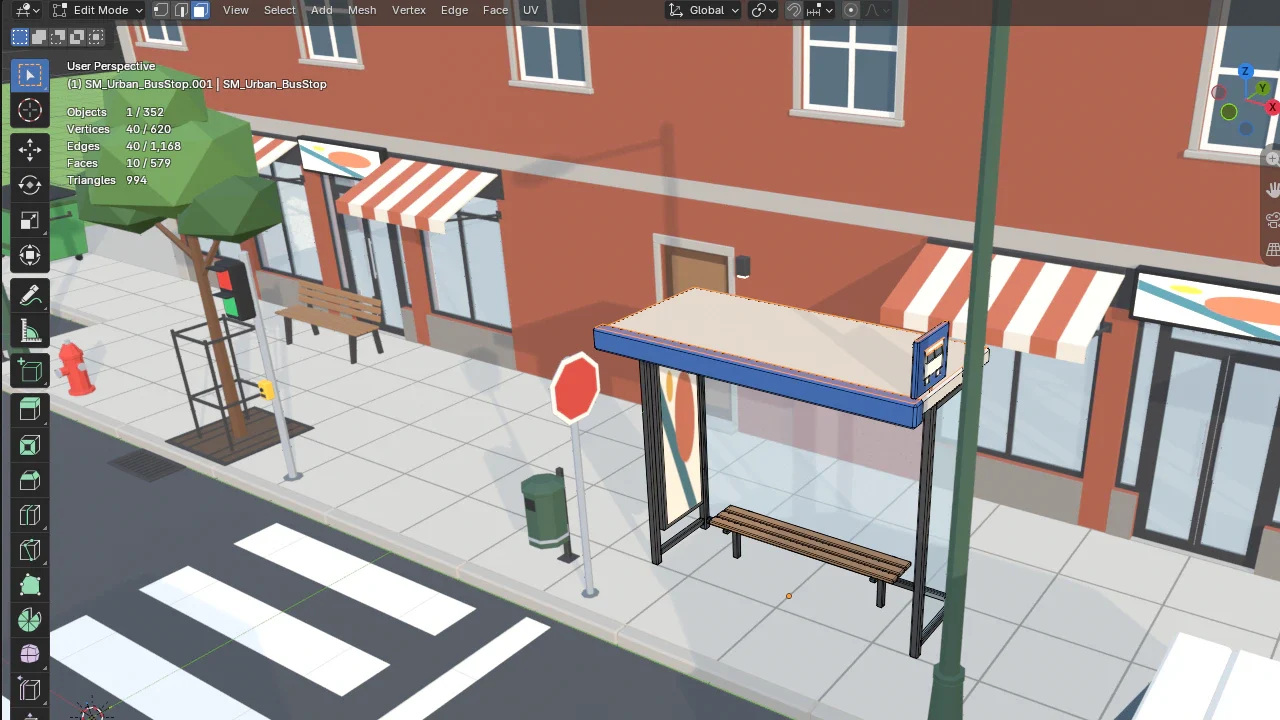
Before making 60 models we made one: the bus stop. It has a bit of everything the pack needs (steel profiles, glass, a wooden bench, a swappable ad panel and a sign), so it locked the bevel size, the line thickness and how strong the colors get. Once it looked right next to a sidewalk tile, everything else followed its rules.
Rules first, models second
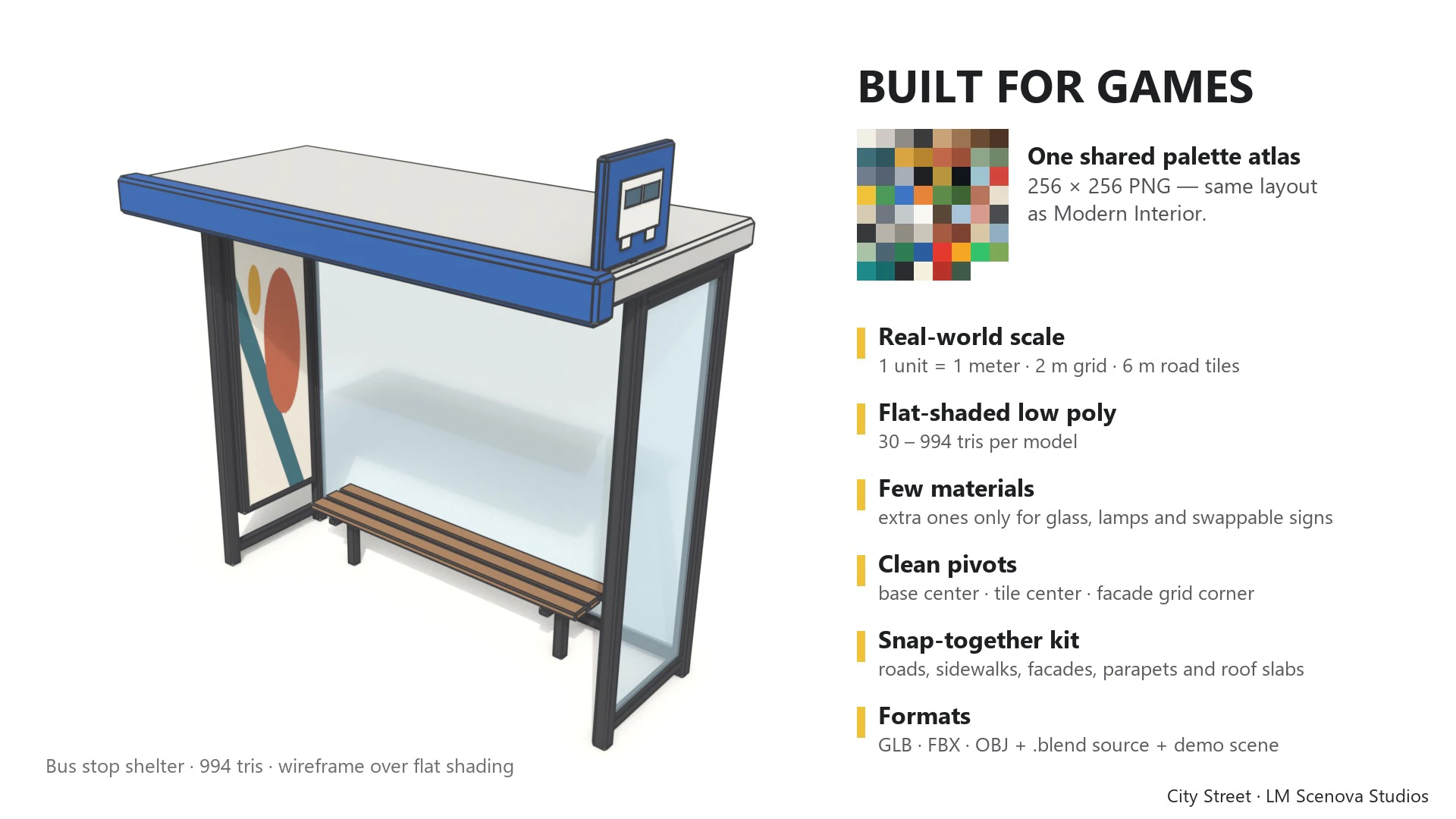
A kit only works if the pieces agree on a few numbers, so we fixed those before modeling:
- 2 m grid for facades and sidewalks, 6 m road tiles (two 3 m lanes)
- 3 m per story, so the Modern Interior rooms fit inside the buildings
- Asphalt at height 0, curb at 0.15 m: every prop sits on the sidewalk without guessing
- One shared palette texture, and it’s the same palette as Modern Interior, just with extra street colors in the empty cells. Both packs can share one material in the same scene

The street taught us a few things
The best test was building the demo scene and looking at it like a player would. It caught real problems:
- Parking ate a traffic lane. Our first “road with parking” tile turned one of the two lanes into parking spots, so cars on that side had nowhere to go. We replaced it with a parking bay that takes the place of a sidewalk row: the road keeps both lanes, and the sidewalk gets wider behind it.
- Signs faced the wrong way. We had them facing the street, but drivers need to see them as they approach. Now every sign and traffic light in the demo faces the oncoming traffic, and the README explains the rule.
- The gas station had no way in. A pedestrian ramp is too narrow for a car, so the pack gained a proper driveway with a lowered curb.
- Buildings were just a front. The first demo only had the street-facing facade. Now the building is closed on all sides and gets a roof slab and rooftop AC units, so it holds up from any angle.
Day and night
Street lamps, wall lights, shop signs and the gas station canopy have emissive lights. Switch to the night palette and the whole street changes mood with one texture swap.
What’s in the box
- 60 models: modular facades, road and sidewalk tiles, lights and signs, street furniture, a full gas station, three boxy cars and geometric plants
- 30 to 994 triangles per model, about 16,600 for the whole pack
- GLB, FBX and OBJ, plus .blend sources and a demo scene with the street and the gas station
- 4 color palettes: default, night, pastel and retro/PS1
- A free sample with 15 models to try in your engine first
City Street is coming soon to itch.io. If you’re making a city builder, a delivery game, a cozy town or a driving prototype, we’d love to hear what pieces you’d want next.